|
On September 21-22, the Green Infrastructure Forum III was held at the Autonomous University of Coahuila’s Digital Library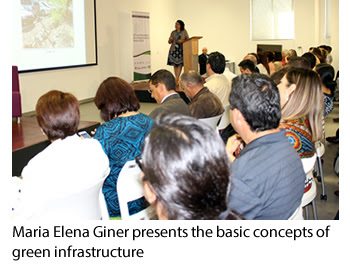 (Infoteca Central) in Arteaga, Coahuila. The event was hosted by the State of Coahuila, the Border Environment Cooperation Commission, the North American Development Bank (NADB) and the U.S. Environmental Protection Agency (EPA). The purpose of the forum was to familiarize participants with the components and benefits of green infrastructure on both sides of the US-Mexico border. Attendees included primarily state and municipal officials responsible for planning, urban development and environmental issues. (Infoteca Central) in Arteaga, Coahuila. The event was hosted by the State of Coahuila, the Border Environment Cooperation Commission, the North American Development Bank (NADB) and the U.S. Environmental Protection Agency (EPA). The purpose of the forum was to familiarize participants with the components and benefits of green infrastructure on both sides of the US-Mexico border. Attendees included primarily state and municipal officials responsible for planning, urban development and environmental issues.
The one-and-a-half day forum included four keynote speakers and four discussion panels on topics such as Green Infrastructure and Climate Change, Social and Public Health Benefits from Green Infrastructure, EPA's Border 2020 Program and Flood and Sediment Control, among others.
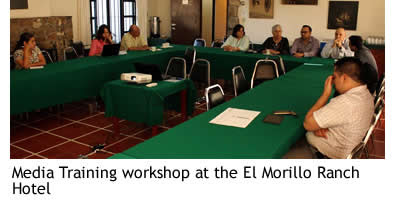 As part of the forum events, on Tuesday, September 20, BECC and the State of Coahuila jointly hosted a Media Training workshop at the El Morillo Ranch Hotel, where media representatives learned about the fundamentals of green infrastructure, as presented by BECC consultant Adrian Vasquez and BECC Program Manager Joaquin Marruffo. As part of the forum events, on Tuesday, September 20, BECC and the State of Coahuila jointly hosted a Media Training workshop at the El Morillo Ranch Hotel, where media representatives learned about the fundamentals of green infrastructure, as presented by BECC consultant Adrian Vasquez and BECC Program Manager Joaquin Marruffo.
The forum events began right after the opening ceremony on Wednesday, September 21, with an introduction by BECC´s General Manager, Maria Elena Giner. Next, Tucson Urban Landscape Manager Irene Ogata who presented "Green Infrastructure and Climate Change". She emphasized that community involvement is paramount to the successful implementation of green infrastructure, resulting in an equitable, social and economic benefit.
"Implementation tasks certainly take time and often the authorities hold back the projects, so joining efforts with stakeholders is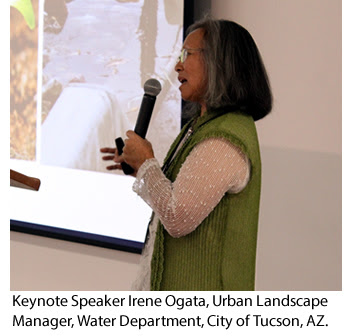 critical to achieve the proposed goals as quickly as possible," said the Tucson official. critical to achieve the proposed goals as quickly as possible," said the Tucson official.
The first panel discussion was "Floodings and Sediments Control", moderated by Dr. Lourdes Romo, General Director of Colegio de la Frontera, Northwestern Area. Aaron Kauffman of Southwest Urban Hydrology in Santa Fe said that over the years we have dried up our habitat. There is surface runoff available that can help create green areas and assist with flooding events caused by severe storms. He presented data showing that rain gardens maintain high soil moisture levels for long periods of time.
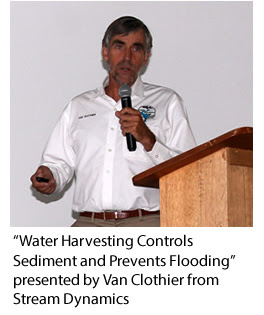 The panel discussion continued with a presentation by Van Clothier of Stream Dynamics, who pointed out that cleaning up city streets after a severe storm is a costly task, given that on many occasions, in addition to removing sediment from the streets, homes and buildings have to be rebuilt. He demonstrated how cost effectivegreen infrastructure elements may be woven into street designs to channel rainwater where it should go. He proposed, among other things, removing concrete from medians and/or sidewalks and taking advantage of the soil to grow native plants, and using a rainwater harvesting design, as has been done in Santa Fe, New Mexico. Mr. Clothier´s book "Let the Water do the Work: Induced Meandering, an Evolving Method for Restoring Incised Channels" was available during the forum. The panel discussion continued with a presentation by Van Clothier of Stream Dynamics, who pointed out that cleaning up city streets after a severe storm is a costly task, given that on many occasions, in addition to removing sediment from the streets, homes and buildings have to be rebuilt. He demonstrated how cost effectivegreen infrastructure elements may be woven into street designs to channel rainwater where it should go. He proposed, among other things, removing concrete from medians and/or sidewalks and taking advantage of the soil to grow native plants, and using a rainwater harvesting design, as has been done in Santa Fe, New Mexico. Mr. Clothier´s book "Let the Water do the Work: Induced Meandering, an Evolving Method for Restoring Incised Channels" was available during the forum.
The third speaker in the discussion panel was Roberto Mejia of the Mexican Institute of Water Technology. He underscored that planning is essential to ensure optimal storm water management, especially managing new developments to implement a radical change in hydrology and storm water drainage practices in natural watersheds to allow water to move without interfering with its natural flow. Above all, he said, it is very important "not to forget that human beings are also part of the environment, and water doesn´t follow human rules but rather, humans must follow water rules."
 Next was the keynote address "How Green Infrastructure Grows Safer, Stronger Neighborhoods and Healthier People" by Frances (Ming) Kuo of the University of Illinois. She talked about the social and public health benefits associated to green infrastructure. Proving this took almost 30 years with the help of scientists and specialists in the field, she said. This occurs because most humans suffer from Green Deficit Disorder, i.e. humans see nature as something luxurious and lavish, therefore, we routinely destroy the few natural areas available to us, creating dry and cold areas. This in turn results in having around us more buildings and residential developments than green areas. She said that study after study, we have demonstrated that we have created unsuitable habitats, this practice has had a psychological impact on human beings and resulted in societal decay. Next was the keynote address "How Green Infrastructure Grows Safer, Stronger Neighborhoods and Healthier People" by Frances (Ming) Kuo of the University of Illinois. She talked about the social and public health benefits associated to green infrastructure. Proving this took almost 30 years with the help of scientists and specialists in the field, she said. This occurs because most humans suffer from Green Deficit Disorder, i.e. humans see nature as something luxurious and lavish, therefore, we routinely destroy the few natural areas available to us, creating dry and cold areas. This in turn results in having around us more buildings and residential developments than green areas. She said that study after study, we have demonstrated that we have created unsuitable habitats, this practice has had a psychological impact on human beings and resulted in societal decay.
"But, how can we avoid a psychological decay?" Frances Kuo Ming asked. Her answer "In a very simple way, by creating green areas. The more green areas we have around us, it reduces the chance of developing some form of depression and mood swings." In support of this, she cited a study showing that one in four people suffering from depression do not have abundant green areas available to them.
She also reported that studies reflect that walking with children through a forested area helps them relax and increases their concentration. Physical decay, consisting of cardiovascular disorders such as heart attacks, hypertension, and heart failure, among others, can be prevented by walking 30 minutes a day through a forested or green area. This is equivalent to spending three hours in the gym and with better results, she said. This tells us that having a significant number of green areas or urban forests reduces the likelihood of suffering cardiovascular disease. She also discussed how much we could save in medication costs if we had more green areas available to us.
The forum continued with a discussion of the Border 2020 Program funded by EPA. The discussion included green infrastructure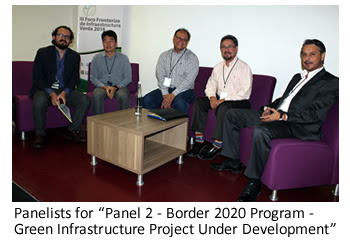 projects currently under development, starting with a presentation by Jose Luis Escanero of the Mexican Federation of Private Health and Community Development Associations (FEMAP), who stated, as was done repeatedly during the forum, that green infrastructure is a key part of both the urban and social settings. He said FEMAP "has been working for over 30 years implementing different models in underserved areas of Chihuahua, where industrious and innovative housewives have been the protagonist" of an initiative to promote "green elements" in housing units. To the extent that this type of "progressive housing" is implemented, the resilience of these families will increase, said the FEMAP representative. In his discussion of the Border 2020 Program, he referred to the eco-housing project in West Juarez, which was funded by this binational program. projects currently under development, starting with a presentation by Jose Luis Escanero of the Mexican Federation of Private Health and Community Development Associations (FEMAP), who stated, as was done repeatedly during the forum, that green infrastructure is a key part of both the urban and social settings. He said FEMAP "has been working for over 30 years implementing different models in underserved areas of Chihuahua, where industrious and innovative housewives have been the protagonist" of an initiative to promote "green elements" in housing units. To the extent that this type of "progressive housing" is implemented, the resilience of these families will increase, said the FEMAP representative. In his discussion of the Border 2020 Program, he referred to the eco-housing project in West Juarez, which was funded by this binational program.
In the next presentation, Diego Sandoval of the Technological Institute of Ciudad Juarez, presented a green infrastructure project located in a public park in the Valle del Sol subdivision, also in Ciudad Juarez. He said the site was selected for its high urban density. Project objectives include:
1. Establishing passive rainwater harvesting systems
2. Reconfiguring existing vegetation
3. Protecting the soil
4. Reducing the impacts of flooding events
He said this initiative has helped establish great communication between area residents through social media, since their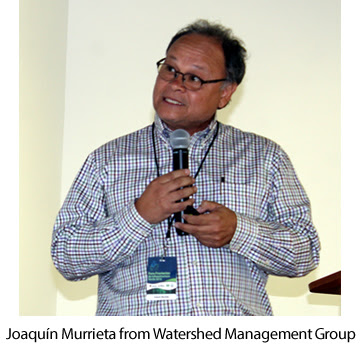 involvement is critical to ensure the project’s success. Support from the authorities has also been obtained to enhance public spaces, since the program must comply with applicable regulations and ordinances at the three levels of government. involvement is critical to ensure the project’s success. Support from the authorities has also been obtained to enhance public spaces, since the program must comply with applicable regulations and ordinances at the three levels of government.
Joaquin Murrieta, Watershed Management Group specialist, spoke on "Flood and Sediment Mitigation in the Border of Both Nogales - Sonora and Arizona" which is another project funded by Border 2020 Program. He said, "there are many ways of looking at green infrastructure. It´s not only about trees, but also about making the best use of rain, which is a critical natural resource."
The panel closed with Jungseok Ho, from the University of Texas Rio Grande Valley who presented "Determination of Ideal Parking Lot Bioswale Porous Material for South Texas" which assessed and analyzed the performance of material susch as pumice, manufactured sand, crush-glass and clean sand used in reducing flooding and recapturing runoff.
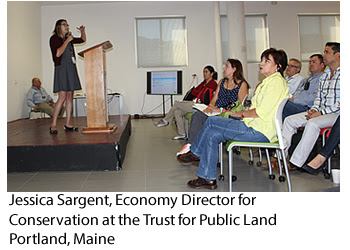 Two keynote presentations and three discussion panels were held the following day, Thursday, September 22. In the morning, Jessica Sargent, Director of Conservation Economics for the Trust for Public Land in Portland, Maine gave a keynote address entitled "Economic Impact of Urban Green Areas" where she presented hard data based on research regarding the economic impact of having urban green areas available. Her research project covered about a dozen very diverse cities or metropolitan areas in the United States. First, the research showed that the availability of these green spaces increases property values by 14% to 20% and this is reflected on more property taxes. Findings also showed that green areas help reduce health care costs and among other economic development aspects, they also support tourism, as urban parks attract visitors from other regions. The "green vitamin," as she referred to, must be present in everyday human activities. Two keynote presentations and three discussion panels were held the following day, Thursday, September 22. In the morning, Jessica Sargent, Director of Conservation Economics for the Trust for Public Land in Portland, Maine gave a keynote address entitled "Economic Impact of Urban Green Areas" where she presented hard data based on research regarding the economic impact of having urban green areas available. Her research project covered about a dozen very diverse cities or metropolitan areas in the United States. First, the research showed that the availability of these green spaces increases property values by 14% to 20% and this is reflected on more property taxes. Findings also showed that green areas help reduce health care costs and among other economic development aspects, they also support tourism, as urban parks attract visitors from other regions. The "green vitamin," as she referred to, must be present in everyday human activities.
There was a discussion panel entitled "Introduction of Green Infrastructure in the Mexican Municipal Legal Framework and its Design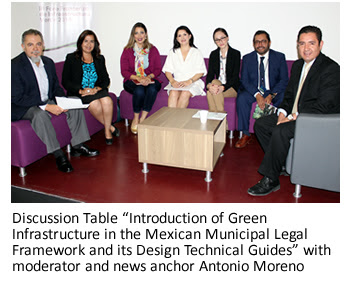 Technical Guides", moderated by a renowned Saltillo news commentator, Antonio Moreno of TV Azteca. The first speaker was Luis Vera, whose firm was contracted by the BECC to conduct a study on the federal and municipal legal framework in six border municipalities with potential for implementing green infrastructure. One of the major findings was the lack of legal efficiency resulting from regulatory differences, overlaps, and inconsistencies. To address that, he said, plans and programs applicable in the context of urban development must be aligned. Currently he is working with Tijuana, Nogales and Ciudad Juarez to integrate municipal code for green infrastructure. Technical Guides", moderated by a renowned Saltillo news commentator, Antonio Moreno of TV Azteca. The first speaker was Luis Vera, whose firm was contracted by the BECC to conduct a study on the federal and municipal legal framework in six border municipalities with potential for implementing green infrastructure. One of the major findings was the lack of legal efficiency resulting from regulatory differences, overlaps, and inconsistencies. To address that, he said, plans and programs applicable in the context of urban development must be aligned. Currently he is working with Tijuana, Nogales and Ciudad Juarez to integrate municipal code for green infrastructure.
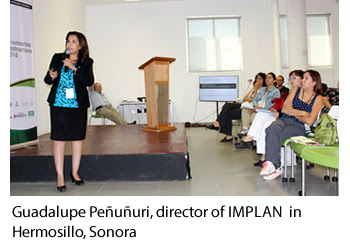 The next speaker, Guadalupe Peñuñuri, Director of IMPLAN in Hermosillo, presented a preliminary design of a green infrastructure project created for Hermosillo, where strategic planning and tools were used to implement green infrastructure components in roadways, medians, parks, residential developments, and water basins or sub-basins. As emphasized throughout the forum, "vegetation must be able to survive on its own or with the minimum amount of irrigation in desert areas," she said and added "we should encourage more participation from the community and relevant agencies involved in decision-making processes." The next speaker, Guadalupe Peñuñuri, Director of IMPLAN in Hermosillo, presented a preliminary design of a green infrastructure project created for Hermosillo, where strategic planning and tools were used to implement green infrastructure components in roadways, medians, parks, residential developments, and water basins or sub-basins. As emphasized throughout the forum, "vegetation must be able to survive on its own or with the minimum amount of irrigation in desert areas," she said and added "we should encourage more participation from the community and relevant agencies involved in decision-making processes."
Additionally she presented the design guidelines that will serve as a tool for all Mexican communities to adopt green infrastructure.
The discussion panel also featured the participation of urban planning officials Nora Marquez of IMPLAN Tijuana, Claudia Gil of IMIP Nogales and Viente Lopez of IMIP Ciudad Juarez. They discussed their experiences in integrating green infrastructure into their local municipal codes.
The keynote address "Adjusting Green Infrastructure to Different Physical and Administrative Contexts" was delivered by Augusto Sanchez of Lower Rio Grande Valley Stormwater Taskforce. He spoke about his experience in various projects located in the Lower Rio Grande Valley, east of the border. Some of the lessons learned from these projects include the following:
1. Thoroughly analyze runoffs.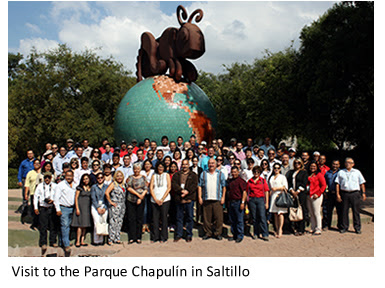
2. Respect and enforce design specifications and details.
3. Manage existing vegetation and other natural elements.
4. Assess locally available supplies and use alternative materials (concrete, glass, compost).
5. Provide for diversity in green roofs, rain gardens, and storm water canals.
He said educating the community is essential, starting with children, so they can learn about and appreciate the adoption of green infrastructure in urban developments. Another element consists of using education campaigns, including signage placed at various locations throughout the city and certainly in green areas, in order to create public awareness. An additional step is to incorporate the municipalities in the design process, as well as multidisciplinary groups, including planning experts, engineers, landscape architects, etc.
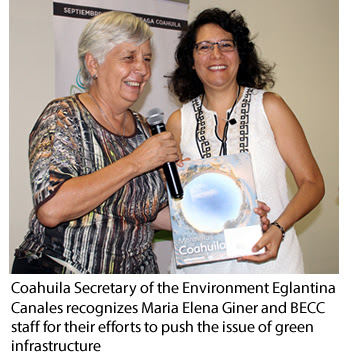 Lastly, the host, Coahuila´s Secretary of the Environment, Eglantina Canales, and Joaquin Murrieta, gave a presentation where they explained the green infrastructure elements that have been implemented in Saltillo, as a preamble to the tour that followed in the afternoon. Secretary Canales said the tasks were developed with the assistance of Department of Parks staff after a workshop where they were made aware of the detailed objectives and the importance of green areas. She said green infrastructure has been implemented gradually in an attempt to transform Saltillo and take advantage of available rainwater. Lastly, the host, Coahuila´s Secretary of the Environment, Eglantina Canales, and Joaquin Murrieta, gave a presentation where they explained the green infrastructure elements that have been implemented in Saltillo, as a preamble to the tour that followed in the afternoon. Secretary Canales said the tasks were developed with the assistance of Department of Parks staff after a workshop where they were made aware of the detailed objectives and the importance of green areas. She said green infrastructure has been implemented gradually in an attempt to transform Saltillo and take advantage of available rainwater.
Upon formally closing the forum proceedings, a tour was given of the local parks and green areas that were retrofitted last year with the help of the BECC/NADB Technical Assistance Program, first in a remote area and later in two public facilities –the Torreon and Chapulin parks. The tour ended at the State of Coahuila's public nursery in Saltillo whose focus has been to grow native plants.
|